
EDUCATION BLOG
EYEWEAR A to Z
Our easy and super-smart guide to everything about EYEWEAR
Accessories
To keep your glasses in the best shape, we’ve got accessories for any scenario—the traveling glasses, the smudgy glasses, the I’ve-got-lots-of-glasses-I-forgot-about-this-pair-of glasses, and more. Keep ‘em clean, keep ‘em safe! This involves putting your glasses in the case when you are not wearing them and cleaning your lenses with the lens cloth given to you when you buy glasses from us. You should also use an anti-fog lens spray along with the lens cloth to keep your blue-light-protective lenses clean. Using your shirt or skirt or any random piece of material will lead to scratches on your lenses.
Acetate
Acetate—or, more specifically, cellulose acetate—is the best form of plastics for glasses. It’s durable, hypoallergenic, and capable of holding exceptionally rich colors, which makes it an ideal material for eyeglasses. Most of our glasses are made of acetate.
Add power
This is a piece of information that appears on your prescription. It refers to the added magnification power you need to see clearly close-up. Simply put, this is the additional power needed to help you read small prints at near.
Amblyopia
Amblyopia is an inability to see clearly through one eye. It arises during childhood, typically when the nerve pathway between the brain and eye doesn’t develop quite normally, and for this reason the eye doesn’t “learn” to see correctly. Amblyopia is sometimes referred to as “lazy eye”…but it’s not very nice to call anything “lazy,” including your eye. So we prefer the scientific term. Amblyopia could also cause the eye to deviate and turn outwards. This deviation is called a squint. In some cases, wearing prescription eyeglasses could help to reduce the deviation of the eye and help the eye to focus straight instead of turning to an outward position.
Anti-reflective coating
This is a coating on your lenses that is made with high-quality super-hydrophobic treatment. This coating is especially important for those who work with computers—and it also keeps your glasses looking really good and polished.
Arm
Also known as the temple, this is the part of your glasses that runs alongside your head and holds them in place. Some persons call it the ‘handle’ of your glasses.
Astigmatism
Astigmatism is a common optical condition which results in blurry vision (and, if uncorrected, sometimes a headache). It results when the curve of your cornea is slightly irregular in shape, which prevents light from focusing properly on the back of the eye. This prevents you from seeing with perfect sharpness. The good news: A pair of glasses can help correct for astigmatism.
Autorefractor
This is a machine used to determine what level of vision correction is right for you. In simple terms, it shines light into your eye and measures how the light changes. An autorefractor helps provide an ultra-accurate baseline for ophthalmologists or optometrists to work from. It is often used on patients when they visit the eye clinic for an eye exam.
Axis
“Axis” is the number on your prescription that determines the direction of your astigmatism correction. The cylinder and the axis always go together—you can’t have one without the other!
Base curve in contacts
Sometimes base curve is also included on a contact lens prescription which helps the lens fit properly. This measurement always falls between the numbers 8 and 10.
Bifocals
These lenses correct two fields of vision—near and distance. It also has a visible demarcation between the near reading portion and the distance.
Blink reflex
Your eyes are the most delicate organ of the body and must be protected! Thankfully, we have eyelids and a blink reflex which ensures that we close our eyes the instant a threat is perceived. Fun fact: We blink an average of once every 3–4 seconds. Blinking helps distribute tears over your eyeball in order to keep it nice ‘n moist (and to wash away bacteria and other foreign particles).
Blue Light Lenses
Firstly, blue light is a subset of light within the visible light spectrum; it’s emitted by the sun as well as screens on computers, phones, and other electronic devices. Our blue-light-protection lenses, filter out a higher percentage of the harmful blue light than any other optical lenses we offer. Wearing blue-light-protection lenses will help protect your eyes from eye strain, fatigue, glare and ultra-violent radiation. Add blue-light-protection lenses to any optical frame of your choice with or without prescription.
Cat-eye frames
Cat-eye frames are a shape of frame that swoop upwards, like…um…cats’ eyes. (You saw that coming.)
A woman named Altina Schinasi Miranda is credited with inventing the first cat-eye-like shape in the 1930s. Miranda was a window display designer in Manhattan who thought most glasses were hideous and unsuitable for fashionable ladies. Inspired by harlequin masks she’d seen in Venice, Miranda got creative and designed a pair of glasses that mimicked the masks. (She snipped the first prototypes out of paper.) Fast-forward a few years and the new style of glasses is suddenly in vogue AND in Vogue. Marilyn Monroe wore them, Nina Simone wore them, Brigitte Bardot wore them…all the cool girls. Now we call them cat-eye frames. You can wear them even if you’re more of a dog person. It’s allowed.
Cellulose acetate
See acetate above.
Color blindness
Individuals with color blindness perceive colors differently from the way most of us do. It’s very common, and the degree of color blindness can range from mild to severe. (Those with very mild color blindness might not even know that they have it.) It’s usually a genetic condition, meaning that you are born with it. Because inherited color blindness is carried on the X chromosome, it affects more men than women. It is estimated that about 8% of all men and 0.5% of all women have some form of colorblindness.
Contacts
If you’re anything like us, you like to have options galore. We are happy to offer a variety of contact lenses to accommodate a greater range of prescriptions and preferences.
Cylinder
This piece of information appears on your prescription. It refers to the lens power needed to correct for an astigmatism. The cylinder and axis always go together—you can’t have one without the other!
Demo lenses
If you order our glasses without prescription, you’ll receive glasses fitted with plano demo lenses. These lenses have no prescription. When you place an order for our glasses with prescription, we customize a fresh pair of glasses with your prescription.
Diameter
You may find a diameter measurement included on a contact lens prescription, which is just the width of a contact lens in millimeters. (Most contact lenses are between 13 and 15 mm wide.)
Dilation
Eye care professionals will sometimes dilate your pupils during an exam to get a better look at your retina. This simply means that your pupils will be widened (or dilated), usually using special dilating eyedrops.
The downside of getting your eyes dilated is that it makes your vision blurry and your eyes extra-sensitive to light for a few hours, or sometimes a bit longer. Sunglasses help a bit. (Safety tip: It’s not a good idea to drive for several hours after your dilation.)
Expiration date
As you age, so do your eyes. (Ugh, why.) Because we are responsible upstanding citizens, we can’t start making your glasses without seeing your valid prescription with our own two eyes. That’s why it’s important to keep your prescription updated.
Eye drops
Eye drops = liquids that you apply to your eyeballs for various purposes. It takes some practice to apply eye drops, because putting fluid directly onto your eyeballs does not exactly feel natural. You can get different kinds of drops for different purposes: itchy eyes, dry eyes, etc. Some drops are medicated to treat glaucoma, eye infections, and other conditions. It’s best to ask your friendly doctor what drops are right for you.
Eyes
The circular thingies on your face that give you an excuse to wear cool glasses. The eye is an insanely complex organ, but it helps to think of it like a camera: It has a lens, it collects incoming light, and it provides an image that your brain interprets.
Eyestrain
If you use your eyes intensely or in certain circumstances—like staring at your computer for too long, or reading a lot of small print—you may get eyestrain. If you have continual eyestrain, we recommend getting your vision checked (you might need glasses)!
Eyewire
The rim surrounding your frame’s lenses
Farsightedness
If you are farsighted, you have trouble seeing near objects, but you can see distant objects clearly. (We know, we know—the name is confusing.) The medical term for this is hyperopia.
Fit
Do your frames fit? Here’s how to tell.
- Pupils should be near the center of the lens
- Lenses shouldn’t extend past the side of your face
- Eyebrows should not be inside the glasses
- When you smile, your cheeks shouldn’t push the frames up
- Frames shouldn’t slide down your nose
Glasses
This…this is what we sell. Glasses.
High-index lenses
“High-index lens” is a fancy phrase for a type of thin plastic lens that comes in handy for some higher prescriptions. This stops your glasses from looking like the bottom of a ‘coke bottle’ (Although high-index lenses are not recommended for children 16 and under.)
Hydrophobic
“Hydrophobic” describes something that does not like water. We treat our premium lenses with superhydrophobic coatings, which repel moisture to help prevent smudging.
Hyperopia
See farsightedness.
iOS app
We have this coming soon…
Jolly
This is how you’ll feel when you put on your first pair of Opticlass sunglasses – happy and cheerful!
Know-it-all
This is how we make you feel when you order your new prescription eyeglasses from us- now you can see the farthest and read as much as you like. You can literally know-it-all. We likey!
Lenses
This is the transparent optical part of your glasses through which light passes to focus the images that you see. Most lenses today are made of standard plastic material which is lighter and more durable.
Mixed Material
Some mixed things are bad (like mixed messages). Some mixed things are good (like mixed nuts). Our Mixed Material frames definitely belong to the second category. These frames include densely-hued acetate and metal flourishes. Yum
Monovision
Monovision is sometimes prescribed in contacts. It’s a pretty neat refractive correction that works by making one lens for distance and the other for near vision.
Myopia
See nearsightedness.
Nearsightedness
If you are nearsighted, you have trouble seeing distant objects. Another word for it is “myopia.” If you’re sitting in the back row of a movie theater and the screen is blurry? Yep, that would be nearsightedness. It’s pretty common.
Nose bridge
“Nose bridge” refers to the slope of the nose in between your eyes. (Put your finger there. It’s a nice little area, isn’t it? Definitely an underrated body part.) A low nose bridge is where the bridge of your nose sits level with or below your pupils. People with low nose bridges often have wide faces and/or high cheekbones.
Nose pads
Twin pads that rest on the sides of your nose and ensure a snug fit.
OD
This abbreviation appears on your prescription. It stands for “oculus dexter,” which is “right eye” in Latin.
Optician
An optician is an eye care professional who is trained to interpret, fit, and dispense prescription eyewear. They don’t provide you with the prescription itself, but they make sure everything is up and running perfectly after you’ve gotten a prescription from an eye doc.
Optometrist
An optometrist is the doctor who gives you a prescription for glasses and/or contacts. They can also diagnose eye diseases and prescribe some medications.
Ophthalmologist
In addition to being an incredibly hard word to spell, an ophthalmologist is a medical doctor who specializes in the treatment and diagnosis of eye diseases, as well as in eye surgery. This person can also prescribe medications, glasses, and contacts.
OS
This abbreviation appears on your prescription. It stands for “oculus sinister,” which is “left eye” in Latin.
Phoropter
A phoropter is a big instrument that your doctor will use for refraction during an eye examination. It looks like a science-fiction mask. (VERY cool.)
Photochromic lenses
These are light-responsive lenses that begin to darken when exposed to UV rays (in both direct and indirect light)—then fade back to clear indoors. The technology is built into the lenses, so the treatment won’t rub or peel off. They’re a particularly useful way to reduce the amount of frames you need to carry.
Plano
“Plano” refers to a lens without a prescription. Just a plain ole’ plano.
Polarized lenses
Polarized lenses eliminate glare, making it easier for you to see without straining your eyes. Polarized sunglasses have vertical filters that prevent horizontal light waves from entering. Voilà: no glare. It’s so simple, yet so cool.
Polycarbonate
Polycarbonate is an über tough transparent plastic with exceptional impact resistance. (It won’t break if you drop it, unlike eggs, crystal vases, breakable plates etc.). We strongly recommend that you choose polycarbonate lenses if you buy a rimless frame and you wish to make prescription eyeglasses.
Prescription
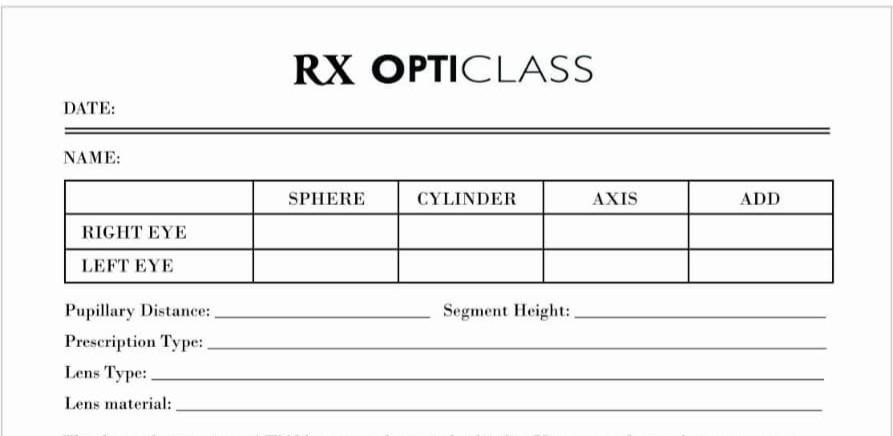
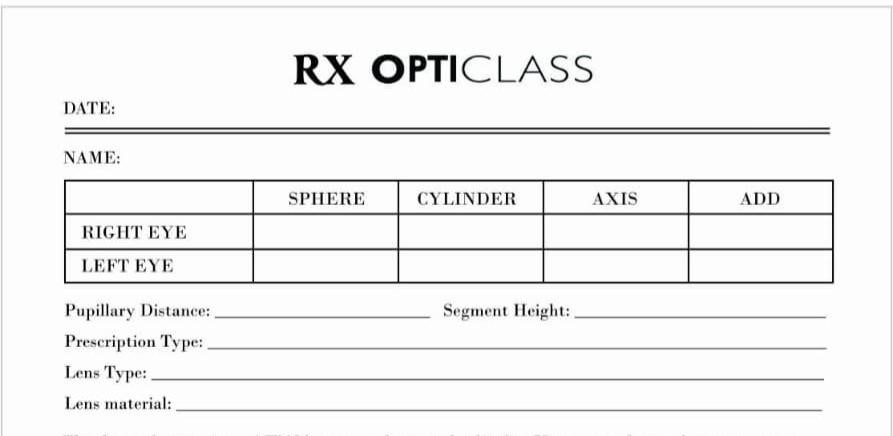
A prescription is a formula for making the best pair of eyeglasses for you. Think of it like a recipe with different ingredients: You’ve got your sphere (to indicate the strength of the lens you need), your cylinder (which indicates the lens power needed to correct astigmatism), and your axis (which indicates where to place the lens correction for astigmatism), among other pieces of information.
Prism
This is a piece of information that may appear on your prescription. If your doctor includes a prism correction on your prescription, you’ll see a little triangle symbol next to it, like this: ∆
Progressive lenses
Progressive lenses are like a fun “two-for-one” deal, offering multiple focal corrections all in the same lens (distance correction on top, intermediate in the middle, and reading correction on bottom). This means you can see your whole field of vision without switching between multiple pairs of glasses.
Pupil
Your pupil is the part of your eye that light passes through at the centre. Your pupils expand and contract depending on the light conditions surrounding you. When light is scarce, your pupil expands; when the sun is blazing, your pupil contracts to limit the amount of light that enters. Like a camera aperture.
Pupillary distance
Your pupillary distance is…drumroll…the distance between your pupils! It’s a handy measurement that helps align your lenses to fit the frames you choose. Your pupillary distance can be measured in a number of ways—there’s even a device called a “pupillometer.” (Great word.)
In an ideal world, your eye doctor will include it on your prescription every time.
Quinoa
Quinoa is a delicious and healthy food. We didn’t have any eye-related words that start with the letter “Q” so we’re going with quinoa, because otherwise the “Q” section will be lonely. Bon appétit.
Readers
Readers (or reading glasses) are glasses with non-prescription lenses that make it easier to read (or do anything that requires really good eyesight at close range). They’re available in various preset magnification strengths, which users can choose from to match their needs.
Refraction
In science terms, refraction is the bending of any wave (but for our purposes, a light wave) as it passes from one medium into another. In eyewear terms, refraction refers to the process of determining your refractive error.
Retina
The retina is a light-sensing layer of tissue lining the inside of your eye. Think of it this way: If the eye is a camera, the retina is your photographic film.
Segment height
Segment height is one of the measurements used to create super-accurate progressive lenses. It’s a vertical measurement (in millimeters) that tells the lab where to start your progression. Sometimes we refer to it as “seg height,” just to be cool.
Single-vision lenses
Single vision lenses correct for one field of vision (usually for distance or reading).
Snellen chart
This is your classic eye chart. You know, the one with the letters that go from big on top to maddeningly tiny on the bottom. It was invented in 1862 by a professor of ophthalmology in the Netherlands named Dr. Herman Snellen.
Sphygmomanometer
First of all, how many syllables does one word NEED? Save some syllables for the rest of us, sphygmomanometer!
A sphygmomanometer is an instrument used to test your blood pressure. It’s that inflatable rubber cuff that squeezes your upper arm in a somewhat uncomfortable fashion. (You know what we’re talking about.) Because eye doctors can sometimes detect signs of high blood pressure in your eyes, they may use a sphygmomanometer to get your blood pressure during an eye exam.
“Standard fit”
“Standard fit” frames are alternatives to Low Bridge Fit frames. Low Bridge Fit frames are crafted for those with low nose bridges (if the bridge of your nose sits level with or below your pupils), wide faces, and/or high cheekbones. If you don’t have these features, you’ll want to stick with “standard fit.”
Temple
Also known as the arm, this is the part of your glasses that runs alongside your head and holds them in place.
Titanium
Titanium is a strong, durable substance that holds up well under force. (Just like you.) We use it to make glasses because it has a high strength-to-weight ratio, which makes it ideal for an item that rests on your nose. Also: Titanium never rusts.
Toric
Geometry geniuses may remember that toric means having two independent curves instead of one. What’s this have to do with my eyes? you might ask. Well, toric contact lenses are used for people with astigmatism, so the prescription will have both a Cylinder (CYL) and an Axis value.
Tortoise shell
In the 19th century, tortoise shell was a prized material for all sorts of household objects, from combs to cigar boxes to spoons to paper cutters. Fancy people stored champagne in tortoise shell ice buckets. It made sense: Tortoise shell is a beautiful material, with complex marbled hues and a rich glow. Even the ancient Egyptians used it.
The problem is that tortoise shell originally came from an actual animal; specifically, the hawksbill sea turtle. This big guy grows to three feet long, has a cute little beak, and enjoys swimming among coral reefs and lagoons. In 1973 the Endangered Species Act was passed, which officially protected hawksbill sea turtles from being hunted. They’re still endangered though.
Here’s where it is important to note that our tortoise shell is NOT made from actual tortoises. We would never do that. Instead, ours is made of custom cellulose acetate. Our designers have a lot of fun concocting tortoise hues of every shade—with no cruelty involved.
Ultraviolet light
Ultraviolet light is a form of electromagnetic radiation that surrounds us, but it’s not visible with the human eye. Our main source of UV light is the sun. (If you’re overexposed to UV light, you can get a sunburn. Be safe out there, guys.)
Visual acuity
Visual acuity is a schmancy way of saying “how well you can see.”
You may have heard the term “20/20 vision” tossed around. That term describes “normal” vision. If you have 20/20 vision, you can see at 20 feet what a person with normal vision would see at 20 feet. It’s possible to have better than average vision—some people, for example, have 20/15 vision, which means they can see at 20 feet what most people can only see at 15 feet! (#jealous). Also, 20/20 vision is same thing as 6/6 Vision. This is because 20feet is the same measurement as 6 metres.
Visual field
Your visual field (or “field of vision”—same thing) is the area that you are able to see when your eyes are in one fixed position.
Windshield wipers
We wish we had these for our glasses. Lol.
X-ray glasses
These are not a thing but watch out for our smart glasses coming soon.
Yes!
This is what you will shout—possibly accompanied by a fist pump—when you put on your first pair of Opticlass glasses. Good times.
Zzzzz
This is what happens when you close your eyes in bed at night. Sweet dreams!